This post was written in 2020, you can find the original post here.
Two years ago, I wrote a note about Start, up and down. I wrote it from the point of view of one of the first employees at the startups I joined. Today, I want to share startups from the point of view of a business owner, after a little over a month of selling Tết gifts.
Some battles last only a month, but take years of preparation.
(All dates in this note follow the lunar calendar.)
Idea
Mid-November 2019 (early 11th lunar month)
A few friends and I had an idea: sell Tết gifts. People buy Tết gifts every year, we wanted to give it a shot, and it was a chance to earn some extra money for Tết. At first there were three of us: me and two friends.
One friend handled the suppliers (NCC) and the inbound logistics. One managed the cash flow and raised more capital if we needed it. I took sales and partners. Lucky for us, each person was good at a different part. Whoever was good at something did that thing. Faster that way.
10/11
Both friends were busy with their own work and projects, so they dropped out. Shock, for about 3 seconds.
We had split the work, and split the money too, to lighten the capital load and share the risk. Now 2 out of 3 people were out, and it was just me. I’d only pictured going to see a few companies run by friends and acquaintances to “ask around” about Tết gifts, then finding a master of ads to run the campaign. Someone else would handle the rest. If I kept going now, I’d have to cover everything myself. And find more capital. Where do you suddenly find a few hundred million dong? It was also only a little over a month to Tết, and I’d have to subtract the 27th, 28th and 29th. Hard to think.
Forget it. Quit.
But wait. Let me see what resources I have right now.
- Packing the finished products. Probably some university students could do that.
- A printer. Luckily I’d found a good one the other day, and it’s inside the city too, so I won’t have to worry much about transport.
- Raw material suppliers: candied fruit, cakes, sweets. I could probably ask my old AhaMove colleagues to help.
- Product photos. This is important. It’s a seasonal product, so I’d focus on Facebook ads. And with good ads, probably 80% of the success comes from beautiful photos and content. I think I know a runner friend who photographs… birds and wild animals. Probably he could introduce someone.
- Running the ads. The most important part. I’m not familiar with it. Do I know any expert in this area? Oh, I do. When I worked in Saigon, I had a colleague who specialized in this. Now he runs his own agency, consulting on and delivering digital marketing solutions. It’s been over three years, and we still talk now and then and stay in touch.
- Operations, logistics and so on. Shipping I know from my time at AhaMove. I still sometimes go and talk to customers there, some with a few hundred orders a day, so I’d learn about operations and shipping in the fastest way possible.
- Money. This is the hard one. I probably have 30% of the capital needed. If the cash cycles well, like closing a few corporate customers who pay a deposit up front, I’d have money to pay the suppliers part of what I owe. Then sell more, pay more, and so on. It might be fine. And at worst, I borrow.
Is anything missing?
I don’t think so.
Let me think about it a bit more. I’d always heard about ownership: treating the company’s work as your own and taking responsibility for whatever happens in it. Yeah, I always tried to follow that spirit, thinking there would come a day when I’d be a real owner, solving a real problem of my own with the resources I had, and living or dying with the business. I didn’t know exactly when. Maybe this was the moment.
One month isn’t too long and isn’t too short. It’s enough to build something from zero. I’d read many business books, about successful entrepreneurs and economic theories. I’d also walked alongside, and witnessed, a business being built from nothing until it hit traction of hundreds of thousands of orders a day and raised tens of millions of dollars. And most importantly, I understood this: if you focus all your energy on one action for a set period, you will gain something. If I made a profit, I’d have more money for Tết. If I made a loss, I’d gain real battlefield experience. Even if the loss was so big I’d work a whole year and still not pay it off. Whatever. Bet big, win big. What I’d win, I didn’t know yet.
Ok.
Race
13/11
First thing: I needed a plan. I used to work on inspiration, many times (sometimes I still do). YOLO style, wherever it goes. But ever since I met a friend on the strategy team at my old company, everything required a plan. A Google Sheet. What resources a fight needs (resources meaning both manpower, which is people, and financial power, which is money), and what scenarios could happen. A project always prepared three scenarios: best case, base case and worst case. Then what to do in each. Always aim for the best case, so that if you fail, you fall back to the base case, an acceptable level. Like “shoot for the moon, even if you fail, you’ll land among the stars.”
At first it annoyed me. Why prepare so carefully? It was the same as going to races in the old days. Why plan training and so on? Just pick up your shoes on race day and run, you’d finish somehow. Except for the two races in Malaysia…
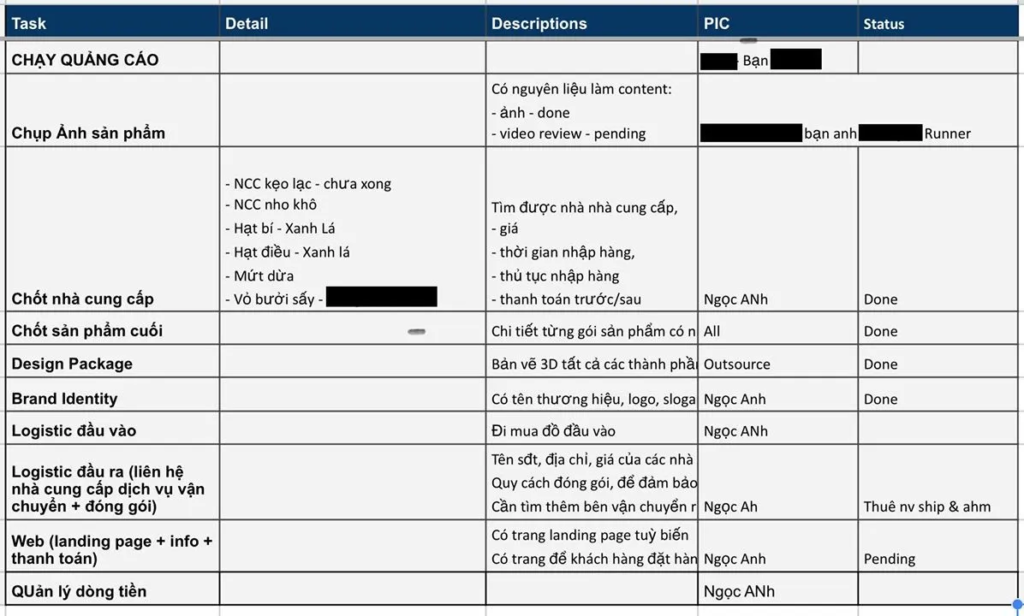
First, find someone to run the ads.
I chatted with my old colleague, and he introduced me to someone who ran big campaigns for several e-commerce platforms, with a budget of a few hundred million dong per campaign being normal. I liked what I heard right away. Phúc connected me with that expert. The two of us talked for a while and I closed on the spot. I didn’t really understand much of what T shared, but I could feel the enthusiasm and sincerity. That was all I needed. Later T also helped me a lot with content, both photos and text.
With the ads person settled, next was preparing the material for the ads.
— Anh H, do you shoot product photos? I need photos of my Tết gift boxes.
— Does your company need that kind of shoot, NÁ?
— It’s just me, anh.
— Just you?
— No company….
— Oh really lol. I thought you opened a company. (Heart reaction)
— Is it urgent? If you handle the styling yourself, I’ll shoot for free. (Another heart reaction)
— Very urgent. But what is styling exactly? I set everything up and you just come and shoot? (Sh*t, I have no idea, anh)
— I don’t usually shoot still life (you know I shoot birds lol). If you want it done really carefully, I can connect you with friends who specialize in still life and product photography.
— Okay, that works. But I need it shot this Sunday (today is Thursday…)
— ….
— ….
A few moments later.
— Ok, I’ll try to get it done for you early next week.
Nice.
Next, suppliers. Tết goods come in five or seven kinds, this and that. Finding cheap sources isn’t hard, but… that’s not great. I wanted to sell what I was truly confident about when I went out selling. The best, the most expensive products. I wasn’t thinking of it as selling Tết gifts, because everybody sells Tết gifts. I wanted to sell a solution for polite Tết gifting, with quality in both the outside and the inside.
I looked at a few Tết gift sellers. Retail was around 500k. I priced mine at 669k. For 10 boxes or more, it dropped to 620k a box. The fillings had to come from the best suppliers too. You get what you pay for. If I’m not going to sell, fine, but if I sell, I sell the best and the most expensive. Decision made.
I never imagined this would be one of the decisions that taught me the most expensive lesson.
Selling nuts, I couldn’t help thinking of (yet again) an old colleague. They opened a shop selling nut milk and nuts more than three years ago. Even before the shop, Gấm was “famous” for macrobiotic eating, from choosing ingredients to cooking. I’d once dropped in to eat for just one day and was impressed, and still am. No need to think much. I messaged Gấm right away. Five minutes later I had suppliers for cashews and pumpkin seeds. They cost more than other suppliers, but I trusted the quality completely. Expensive has its price.
Next, dried pomelo peel. Google. Anything I don’t know, I google. I found a few sellers, called to check, and the next day went to check one in person, with a workshop in Saigon. They buy pomelo peel from VietGAP-certified farms. They had invested in machinery and technology, and produce to standards for export to Japan and Europe. The quality test papers and the self-declaration of the product were complete. So I felt reassured about the origin. I tried it. The peel was soft and fragrant, kept the bitterness of pomelo essential oil but was sweet, with a scent of honey. Very good. Only the price was a little high. They were retailing at almost 70k for a 100g bag. That’s many times the price of other suppliers. I sat down and worked out how many kilos I’d need for 1,200 boxes. Five, ten, fifteen, twenty…. Done. “If I take … kg, what’s the price?” It came down a little, but still quite a bit above market price. Never mind. Expensive has its price.
Like that, the last three products, raisins, coconut jam and peanut candy, also took a while to find suppliers I liked. I took the peanut candy from a family in the ancient village of Đường Lâm. They make candy by hand, and their product meets the standard for sale in supermarkets for Japanese customers, at a price much higher than domestic. Same product, but with more careful design and packaging and a more attractive story, it sells for a higher price. Sounds familiar.
The final product, and the most important: liquor. Nobody wants to drink bad liquor and have a headache for days. Me neither. I googled for a while and found too much information. Swimming in a sea of information, I suddenly remembered I knew some serious drinkers.
— What liquor is actually drinkable, anh?
— A lot.
— “A lot” like what? Give me a few names.
— The North has some famous strong liquors: Kim Sơn Ninh Bình liquor, Hà Nam duckweed liquor, Vân village liquor in Bắc Ninh, Quảng Ninh ba kích liquor,…
— Why would anyone give ba kích liquor for Tết? And I’m selling to office workers. Giving liquor like that is easy to misunderstand. Like a guy giving it to a girl….
— Who’s going to Hưng Yên tomorrow to test the liquor?
— Why test?
— To sell it, don’t you have to test whether the liquor is okay?
— You’re selling to office workers. They’ll drink any liquor, no need to test. But if you do, you’re the best tester.
— We have to drink.
— Ngọc Anh should sell hangover pills too.
— Bundle them in the combo. Never say lol
— Or mix it right into the liquor, advertise “great liquor with no drunkenness” lol
— How many boxes are you making?
— 1,200.
— You make 400k per bag (wtf??).
— 1,200 bags.
— 480 million.
— 2020, 2021 go on a trip.
— You plan to sell all 1,200 bags?
— Leftover stock for next year.
— Change the label.
— The liquor will be even better.
— lol
After a good round of joking around, I ran down to Hưng Yên to meet a family that had been distilling for more than 15 years. A friend who once cycled across Vietnam with me, and who lives in Hưng Yên, introduced them. I went in person, saw how they ferment and distill, and tasted it before I felt reassured enough to go back to Hanoi.
Suppliers and products, done. Next, brand identity.
What should I name it?
I vaguely remembered reading somewhere about naming brands. A brand that ends in a vowel or a level tone is easier to read and remember. I still remember a time when companies followed the formula of ending in O, I, A. Halida, Huda, Litado, Opixar…. The classic is Kinh Đô, two level tones, and it also suggests wealth. Whoever named that brand was f***ing good. Then Huda, Tiger,… If you can’t find a word with level tones, ending on a level tone is fine too, like Phúc Long,… But that’s theory. When a company gets big, any name sounds good.
Okay, what message do I want to send? Tết in the old days and modern Tết? Then and now? Traditional, but with modern beauty? Tết Xưa — modern traditional touch? Sounds okay. Fine, settle on that. If I think of a better name later, I’ll deal with it then.
Website. At first I planned a landing page. I tried Ladipage, but to make it good I’d have to customize a lot and couldn’t use their default theme, and customizing takes time and resources. I was alone, and finding a web person and sitting down to settle the idea would take quite a bit of time. Prioritize what matters. With the time and resources left, I should focus on Facebook only. The website, Shopee, Tiki and the rest could wait until next year.
On operations: closing orders and shipping, I also used tools. I managed comments and inbox with Pancake, and after closing an order I used AhaMove to batch orders. Depending on whether the customer needed it urgently, with instant delivery, or wanted to receive it during office hours, I would match the orders accordingly.
Done. Every part of the preparation was ready.
Start
19/11
Once the photos looked great, we put up the content and ran the ads right away. Thư set up the ads with just a few criteria: age and location. I was a bit surprised, because targeting that wide, I didn’t know if the ads would reach the people who actually needed them. But I trusted Thư, so I didn’t interfere.
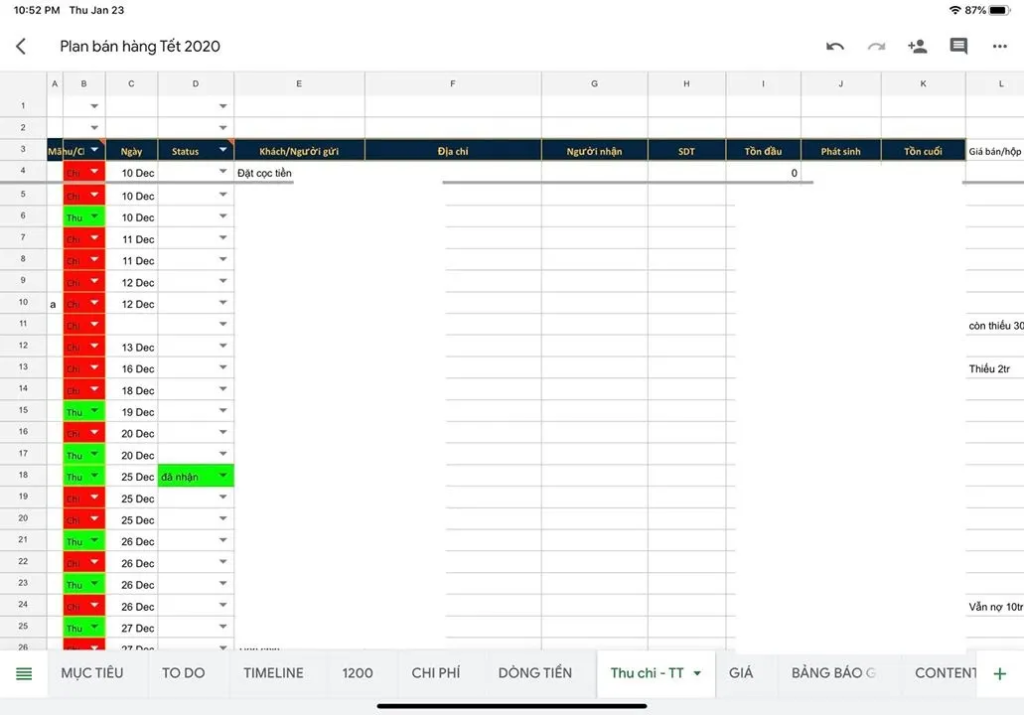
The first spreadsheet only had these columns: Income/Expense, Date, Opening balance, Incurred, Closing balance. Later I merged the information of customers I’d closed into it too.
The income and expense sheet was red all over, like the stock market hit by Corona. Money going out like rain on the night of the 30th, money coming in nowhere to be seen.
For the first ad, I asked friends to come in and interact so it would look good. Thanks to that, some people saw the information through my friends’ shares. Everyone needed a few boxes up to a few dozen boxes for their company. Great. The ad wasn’t even approved and so many customers were asking, 1,200 boxes might not be enough. My replies were smooth. But after every quote, the response was “I’ll message you when I need it.” Okay, tag them in a group. I reminded that group from time to time, but the answer was usually seen and no reply. Maybe my price was a bit high. Never mind. Expensive has its price.
20/11
The ads got approved. They started eating money. I’d prepared answers for when customers asked, and fired them off whenever a comment or inbox came in. The page’s message response rate was 100%, within seconds, f***ing top. But the answers were still “I’ll message the shop when I need it.” Out of 10 customers, 7 or 8 said that. I kept comforting myself, “don’t worry, expensive has its price,” but reality kept slapping me. In the first week, more than 100 customers messaged the page, and I closed one order of two boxes. By my estimate, after the first week I should have collected at least a few dozen million to pay suppliers, but I was holding 1,200,000. The good news: a customer accepted 650k a box. The bad news: the cash flow was deeply negative.
Keep the price and believe that “expensive has its price”? Or cut the price, hoping to sell more and use the cash to keep rolling? If I held the price and was lucky enough to survive past the middle of the twelfth month, meaning many people would later accept buying at the current price, I could tell it later: “Wow, thanks to my persistence and iron belief, I succeeded and made a profit.” If not, I’d write the story: “How I built a pile of debt from nothing.” I’d read both somewhere. The first, probably in the news. The second, my friends often joke about. Now both could become true, and I was the main character.
What should I do?
Usually I’m so confident dissecting other cases, and now I f***ing didn’t know what to do. Hilarious.
There’s a very hard-to-resist magic in being the hero of your own story. Mario eats a mushroom and clears nearly a dozen levels to save the princess. Nice. That’s also the more familiar ending. But now, in this moment and these circumstances, the hero doesn’t exist. The numbers on the sheet don’t lie.
I had to change.
DNF?
23/11
The U23 team and the World Cup qualifiers seemed to be on. Forget it. Forget everything. At this point I only wanted to sell goods, never mind football. And I’d also registered for the VNExpress Midnight Marathon and VMM at exactly this time. Dropped them. I hadn’t registered for the recent races anyway, I always showed up right at the last minute. Oh wait, a few seniors had messaged the other day about forming a team to register for a good discount. Actually, forming a team isn’t hard, but it takes a lot of time to announce it, remind people to transfer money, and deal with changes of information later. And I was running two jobs at once. Where was the time?
But fine, let me open group registration. How often does Hanoi have a night run? Before, we always had to support each other for night runs. Now there’s an organizer, so I have to join in.
I decided to change the price, lowering the retail price from 669k a box to 620k. A cut this deep made me feel a little guilty toward the customers I’d advised before. But I’d rather feel guilty than carry a lump of debt. Truly, being too nice makes business hard.
But the nightmare wasn’t over.

More customers asked for the price and didn’t buy. Same familiar flow. The customer asks the price, I give a whole spiel, and the customer says nothing. Or, more politely, “Thank you shop, I’ll contact you when I need it.”
The goods weren’t selling, but everything still had to follow the plan. The ads kept eating money at a steady pace. I had to start ordering materials from suppliers and start paying the students. The cash flow stayed negative. What had to come, came. I ran out of cash. Done for. For a startup, money is blood. No money, no blood. I’d heard it so many times, and only now did it sink in. I was finally the main character in my own story, but it tasted so sour.
I’d come a long way by now. Stopping wouldn’t get back the money I’d already spent. Stopping meant debt. Continuing meant a high chance of debt. But still better than stopping.
Fight on.
Recover
24/11
If you haven’t borrowed money, you haven’t really been in business.
— I’ll lend you … more to make it a round …
— Ok, I’ll pay it back before Tết.
— Alright, I’ll transfer it this afternoon when I’m in a good mood.
— Why didn’t you tell me sooner, I just bought a pair of shoes …
— Tomorrow I’ll go to the bank, withdraw my savings and send it to you. Pay back before Tết is fine.
Everything that happens in life has a reason. Some things seem accidental, but end up meaning something. If, for Đen Vâu, “because of rap, life turned a page”, then for me, “because of running, life turned a page.” Thanks to running, I got the chance to meet so many more people, and strangers became familiar.
Almost two years ago, a group of runner friends and I happened to go together to Pù Luông for the VJM race, happened to stay in the same guesthouse, and now almost half of the people in this photo are not only running mates but also investors, supporters, and more, up to this very moment.
There are many more people not in this photo who still support and help me, one way or another.
Got my blood topped up.
Live on.
I used to wonder, why should anyone be in debt? For example, a company owing its supplier money is bad, unfair. A company paying salaries late is running a sloppy business. Only now, holding money to pay suppliers after getting a few extra days to settle, did it sink in. Nobody wants debt. But sometimes debt is an art. Between being known for playing dirty or unfair, and surviving, if you had to choose, which would you choose?
It reminded me of playing football in high school. I didn’t like dirty play or tricks either. But I remember one match against an older class. One guy played dirty and shoved me a few times. I showed nothing. Then in a contested ball, he tried an elbow, and luckily I dodged it. I figured that if this went on, the next ball would probably catch an elbow, or my leg would be “accidentally” stepped on. So I played rough right away. I still remember some girls walking by that day saying I played dirty. Well, it’s not hard to judge the choices of the people on the pitch from outside. But it’s not easy when you’re on the pitch yourself, facing a few elbows, and have to choose.
29/11
The joy of the new blood didn’t last long.
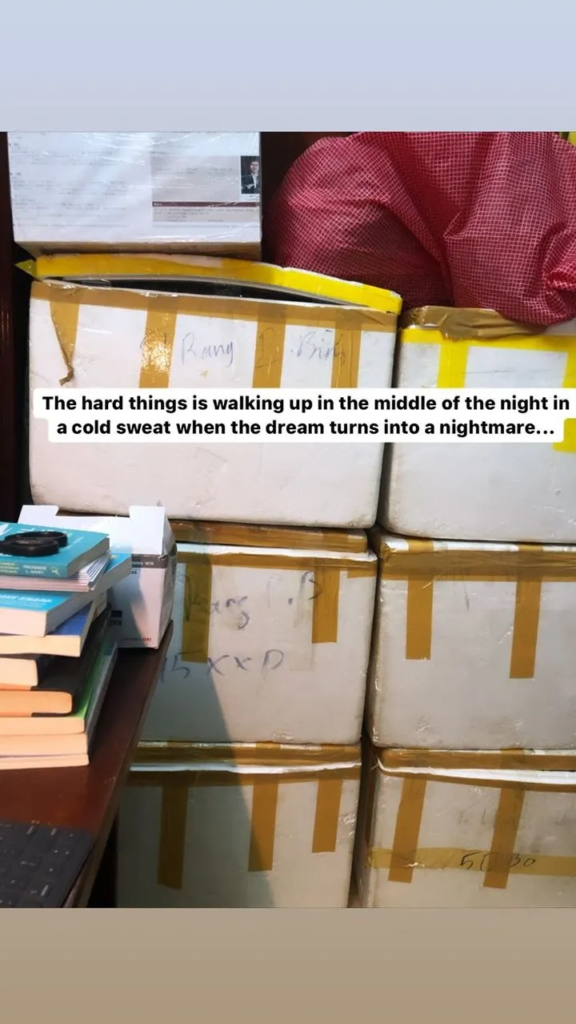
Why, even after cutting the price like this, was the buying rate still low? Raw material cost normally takes 30%, 35% at most, but mine already took nearly half the selling price? Why, when I’m selling something so good, aren’t people buying?
Three weeks to Tết and I’d sold only a few dozen boxes. The future of building a pile of debt from nothing was getting clearer. Since it’s unsold anyway, I’d give some to friends. In other years I bought books as gifts, but this year, homegrown it is.
The page’s organic reach was pitiful. After a lot of thinking, every post got only a few dozen reach. F*** Zuck.
— Anh, let me try posting these photos.
— Show me.
“How would these silly photos get high reach?”
“Oh well, let Mai try. Reach is trickling anyway. Who knows.”
— Yeah, they look okay, think about trending content too.
Wow, the silly content got organic reach several times higher than my own posts.
This one too.
So how does that work?
3/12
— Have you two worked part-time anywhere before?
— Yes, Mai and I managed pages and advised customers buying online.
— Nice. Then you must have experience advising customers. Try it in a moment.
A customer sent an inbox.
— If I buy five boxes, is there any discount?
Normally the discount starts at ten boxes, but at this point, five boxes got a discount too.
— Oh, let me. Our discount starts at ten boxes, right, anh? Let me try advising. For five boxes, free shipping should do.
— (Wtf?) Okay, you try.
— …..
— I’ll ship it to you this afternoon, to …
— Yes. Have a lovely afternoon ❤
F*** me, a heart. Do customers like it that sappy?
It seemed that ever since Mai wrote the content and Hiền advised the customers, I was selling more. After Hiền closed an order, Mai booked AhaMove to ship it. Smooth as clockwork.
Was I really worse than these two?
Even Hằng now packed both carefully and fast, much better than I used to. Hằng trained Ly and Tâm for just a short while, and they were doing nearly 200 boxes in a day.
I might know how to do content, how to advise, how to do a bit of everything. But to be really good and specialized in one particular area, I’m probably not as good as Hiền, Mai or Hằng. I even lose to Ly and Tâm. Because I never focused on any one thing for long enough. Everything stopped at knowing.
“The problems with being a child is that all you’re is potential and its really low resolution. You could be anything but you’re nothing. So you need to pick your damn sacrifice, because the sacrifice is inevitable. And then you become at least somethings and when you’re something that makes the world open up to you again. This is what the sentences find your child when you become an adult mean.
You can either choose your damn limitation or you can let it take you unaware when you’re 30. And I think its more and more common in our culture because people can put off maturity without suffering an immediate penalty.” — Jordan Peterson
9/12
— How many boxes did these two make yesterday afternoon, Hằng?
— A bit over a hundred, I think. I haven’t checked again.
— Mai, tonight prepare content for tomorrow.
— But I’m out of ideas, anh.
— If you’re out, think harder. “That was before, now it’s like this.”
— Oh, if you’re out, take tomorrow off and I’ll write it (the reach dropped again). Tomorrow go ship and meet customers for some inspiration.
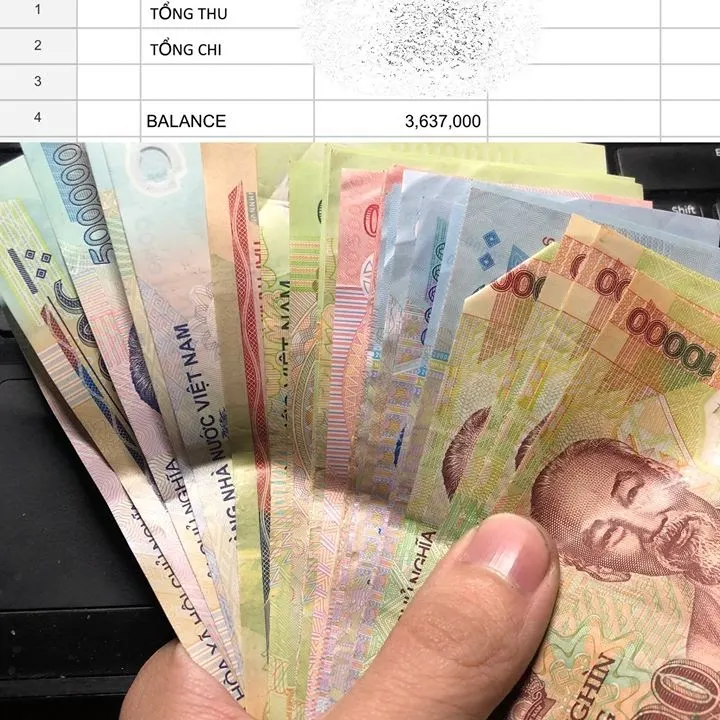
Simple joy is when the cash in your hand and the cash on the balance sheet differ by 30k.
— Anh, I just closed a customer for 30 boxes, at the price …
— Wow, that high?
— Yes, not everyone is as stingy as you, anh lol
“Oh sh*t…”
10/12
— I just closed 50 boxes with Lotus.
Lucky to get a good deal. I wasn’t shy with these guys at all lol
15/12
— Are you close to breaking even, anh?
— Not yet, a long way to go. Over 600 boxes more (actually over 800). If we don’t sell them by Tết, each of you takes some home and eats them slowly lol
— No, I believe you’ll sell them all by the 27th. Will you sell until the 27th?
— No, I’ll sell until the 28th, and go home on the afternoon of the 29th.
— Then Mai and I will work for you only until the 23rd.
— Huh….
16/12
— Tell me your addresses, I’ll ship you Tết gifts.
— Wow, are you in profit now?
— Profit, my ass. A gift is a gift.
— Keep it for selling. If you invite us out for drinks, we’ll come.
— Anh Hà has posted. The content is f***ing good lol
Not only anh Hà but many brothers, sisters and fellow runners shared and recommended it. From Hanoi to Saigon. Some offered to ship to Saigon, but honestly I had no time then to pack and go out to send it by express delivery. A pity. The feeling of being supported and recommended by so many people voluntarily (even if a bit “pressured”) is when I feel truly lucky. Lucky to be here, to witness this much help and care.
20/12
— The 30-box customer from last time just took 7 more boxes, anh.
— Nice. For 7 boxes, let me book a Grab car.
— No need, Mai already shipped it by AhaMove.
— 7 boxes and AhaMove shipped it? (How can???)
— Yes, they stood there talking for a while and the driver had to go anyway lol
11:30 pm, alone in the warehouse, with no idea where tomorrow morning’s money for the suppliers would come from. Trembling, worried and excited all at once. Because I knew that however 28/12 turned out, this would be one of the most memorable periods of my life.

In the words of anh Lê Hồng Minh from VNG, I was building an uncertain future. Accepting that you do things when you don’t know if they’re right or wrong, and have to make decisions in a short time. Because if you wait until the problem is defined, sometimes the chance has passed. Then there’s the matter of teammates who aren’t strong enough yet, who haven’t grown as fast as the business. Because business grows when people grow. The risk is there. A lot of it. But that’s part of business. Luckily this time I had teammates who were very capable and tough.
As a business owner, you’re also a product manager. The product here isn’t only the product (the Tết gift box) but also people. How do you design the most effective way of working? How do you create a work environment that isn’t too comfortable, so results still come, but also not so pressured that people lose their motivation?
21/12
— Lots of inboxes today, I just raised the ads budget. Hiền and Hoài, watch the messages. Hằng, Ly and Tâm, try to make more than today. Mai, is the content done?
— For orders of 10 boxes or more, Hằng and Mai take turns going along by Grab. Today’s target is 300 boxes sold.
— So what do you do, anh?
— I cheer and buy food for you guys lol
23/12
— For you, I’ll give it free, no buying and selling.
— Just count it against the debt.
— Even though I don’t know when I’ll pay the rest lol
— I don’t remember how much it was. Anyway, pay me some so I can use it to pay the suppliers.
25/12
— Tonight let’s finish work and go eat. Hiền and Mai go home tomorrow, so let’s celebrate today.
26/12
— Do you know … ?
— Yes. Why?
— Then connect me, please.
— Done. I’ll pay your salaries and lì xì now. Thanks to Hằng for helping with the timesheets, so it was easy.
— Thank you for helping me for almost a month. Without you, I couldn’t have pulled it off.
Done. Everyone had gone home. Only I was left in the warehouse. For more than a month I’d been running back and forth between home, the company and here, always with voices around, and now it was really quiet. It was f***ing windy outside. I remember reading a story about a new company’s Tết, where the boss scraped together money to pay staff salaries and bonuses, and then had just enough left to take home to his wife for Tết shopping. Sitting alone in the warehouse now, probably it felt the same, except I had nobody to hand it to. Oh, I forgot: I had to take it home and pay debts.
We’re always taught how to be a good employee. Work hard, and success will come. Work hard in silence, let your success be your noise. Well, maybe that’s only half true. If you’re Sơn Tùng MTP, you work hard in silence, and when you need noise, you can make it. If not, most likely you stay completely silent. If you spend time networking and going to events, you have no time to build the product. But if you only focus on building the product, there’s no sales, so there’s no money to live on. I still remember anh Leo Trieu saying that a startup should balance building the product and sales. It’s also the idea in the book Traction by Gabriel Weinberg and Justin Mares, if I remember right.
But the question is: what is balance? Or when should you sell, and when should you focus on building the product? A hard question. The line between surviving or not, and then between scaling or not once you’ve survived, depends a lot on decisions like these. If you wait for a great product before selling, you may miss the timing. But if you sell well an “okay” product, it can also flop easily. How do you find the balance point?
In the same way, if you treat yourself as a startup, when is the time to sell, and when is the time to build the product? Also a hard question. Sell too much and there’s no time to build yourself up. Focus on building yourself first before going out to sell, and you may miss the chance. But either way, only you understand what’s most reasonable to do. Because each person has a different personality, conditions, circumstances and environment.
“So who am I among all those grains of sand in the desert?…” — Điều phi thường nhỏ bé — Đen Vâu, Hoàng Thuỳ Linh,…
A loss of a few (tens of) million, but I got to know many young and capable people. Trusting Vietseeds was not a mistake. By chance again, I knew the Mama of the whole Vietseeds team from UpRace — thanks to running again. This time I also got to know a few corporate customers and suppliers.
A loss of a few (tens of) million, but I went through the feeling of ups and downs a few times in one month, and the feeling of pride and confidence when my teammates were better than me. Going alone is fast, but to go far you need a team.
A loss of a few (tens of) million, but I learned to play bigger games and it opened up many new opportunities. If I only saw what I was seeing and did what I was doing, it would be hard to get the chance to fight battles beyond my ability. Big money plays by the game of big money. Small money has its own game. But playing the big money game is still more fun. And the most fun is playing my own game, or feeling that I’m truly part of the game. Each battle like this stacks up more confidence for the next, bigger battle. Once you’ve smelled business, the feeling is different.
So it was worth it, wasn’t it!
“Don’t follow your passion. Because passion is somethings like emotion. And emotion can change. Follow your contribution” — Ben Horowitz